Researchers from CEA and 3SUN have studied the potential of encapsulants known as UV-DS for UV Down-shifting. The results show that they can improve the performance and reliability of heterojunction photovoltaic modules, with a power gain of up to 1.5%. A scientific article published by Progress in Photovoltaics Research and Applications highlights the promising role of these materials in preventing degradation due to ultraviolet radiation, a major challenge for advanced silicon photovoltaic technologies such as TOPCon and heterojunction.
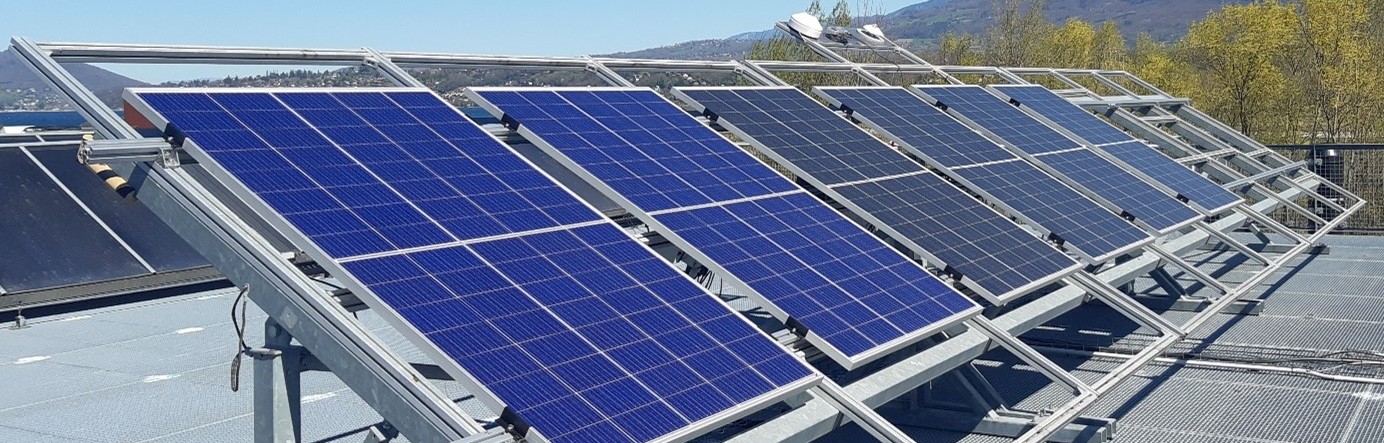
Installation et suivi des performances des panneaux solaires contenant les encapsulants UV-DS sur le site du CEA à l’INES
Crédits : CEA
Sun protection for photovoltaic systems
Published on 03/10/2026
The sun's ultraviolet (UV) rays are not only harmful to your skin, they are also bad for photovoltaic panels, causing power losses and premature degradation of solar installations.
The study tested and verified the behavior of new encapsulants (1) – EVA/POE/EVA (EPE) – which contain luminescent molecules that convert harmful UV rays into blue light (UV-DS).
The findings are promising, with a power gain of up to 1.5% compared to conventional encapsulants under standard test conditions. Tested in real outdoor conditions over several months, these new materials confirm this energy gain and reveal that this benefit is highly dependent on daily UVA content, with greater gains observed in summer, when the UV content of the solar spectrum is at its maximum.
The following are some of the other findings from this research:
- UV-DS additives did not cause any new types of degradation under humid heat conditions (3,000 hours);
- The presence of EVA in the EPE structure in contact with solar cells did not affect reliability;
- A small fraction of high-energy UVB photons (5% at 300 nm) still pass through, suggesting room for further improvement.
- As these additives are subject to significant photo-oxidation, it is better to use them in a glass/glass structure.
The future applications of these encapsulants are promising, particularly in locations with high level of UV radiation, where their advantages are most significant.
- A photovoltaic panel consists of photovoltaic cells that are interconnected and protected by a stack of materials. This stack ensures the mechanical strength of the object and protects the cells from air and moisture while providing the best possible optical conditions. Encapsulation films are key elements which, during the lamination stage, seal the “sandwich” of materials.