The CEA at INES is developing a prospective Life Cycle Assessment model for solar photovoltaics. What for? By looking ahead to 2050, based on various geopolitical scenarios, the model seeks to evaluate how the European industry could position itself in relation to the competition, and to guide players and innovation.

Photovoltaics in 2050: a prospective view of their environmental impact using LCA
Published on 05/20/2026
The European Union aims to increase its industrial sovereignty to 40% of its strategic technology needs for the energy transition by 2030 (*).
Consequently, the regulatory framework for photovoltaics now incorporates criteria beyond just price, such as carbon footprint and material criticality. This requires manufacturers to evaluate and disclose the Global Warming Potential (GWP) of their emerging solar technologies.
Life Cycle Assessment (LCA) provides a robust approach for quantifying environmental impacts across the entire photovoltaic value chain, from polysilicon production to module assembly. The primary impact drivers remain the electricity mix, silicon purification and silver consumption. As photovoltaic deployment reaches the terawatt scale, life cycle assessment is essential for guiding sustainable technology choices.
However, a ‘conventional LCA’ is static and retrospective, relying on data that does not change over time, which can be misleading when comparing emerging technologies. In contrast, a ‘prospective LCA’ accounts for temporal changes in both foreground data, directly related to the system under study – such as the materials used and energy consumption – and background data, drawn from external databases – such as raw material extraction and electricity generation.
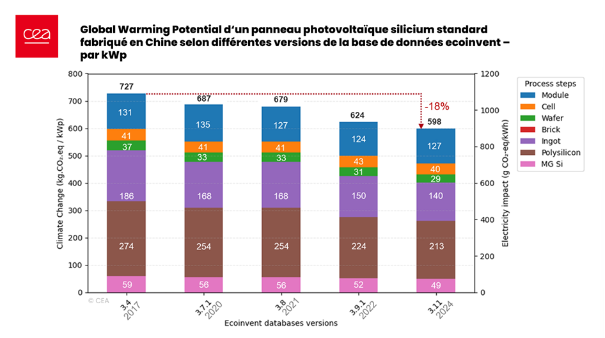
For example, if you calculate the environmental impact of a Chinese solar panel using different versions of the ‘ecoinvent’ reference database, you will see an 18% reduction in its GWP between version 3.4 (2017) and version 3.11 (2024). This is mainly due to China's efforts to decarbonize its electricity mix and highlights the importance of taking into account how background data changes over time.
As the ‘prospective LCA’ approach is relatively recently developed, most of the studies carried out and published for the photovoltaic sector are subject to bias. They tend to modify only the foreground data while using static background databases, which leads to temporal inconsistencies.
Researchers at the CEA’s INES are studying this issue and, in particular, are developing a prospective, parametric LCA model for photovoltaic modules. This model incorporates projected changes in both foreground and background data.
To analyze a typical silicon photovoltaic panel in line with current market trends—taking into account, for example, its manufacturing country—we include the changes it is expected to go through over the next few decades: reduced material usage, improved efficiency, and process optimization
Background data, such as the energy mix of the countries concerned or resource extraction, are projected up to 2050, based on one or more reference geopolitical scenarios.
This approach provides decision-making support and is designed to guide research and policymaking on emerging photovoltaic systems to address the challenges of limiting global warming and preserving our sovereignty.
We will soon be sharing further results from studies based on our model, notably at the PV-SEC international conference in September 2026.
This work is part of the LCA-TASE project (ANR-22-PETA-0010), managed by the National Research Agency (ANR) as part of France 2030, and is supported by the French government.