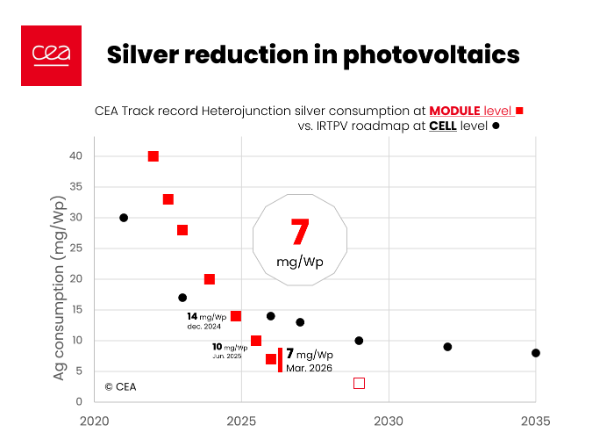
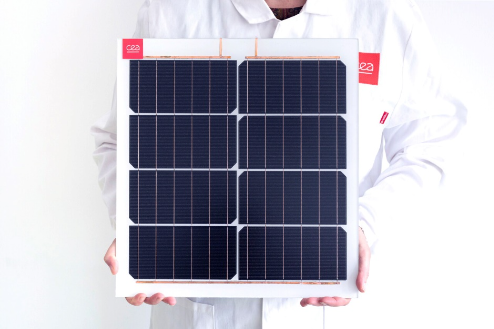
By introducing an all-copper metallization on the back of the heterojunction cells, the total amount of silver in the panel has been reduced to 7 mg/Wp. Our result relates to the panel as a whole—that is, the cells and their interconnection—further highlighting our teams’ lead in addressing these resource and competitiveness challenges.
A scientific article details our latest findings regarding the reduction of silver consumption in ECA interconnections for heterojunction solar cells.
Performance and reliability assessments were carried out on heterojunction panels manufactured using various combinations of copper-based metallisations, ECA and ribbons. Initial tests, carried out using uncoated copper ribbons, silver-copper metallized cells and low-silver-content ECA, achieved a total silver consumption of less than 14 mg/Wp. The results show that panels with silver-coated ribbons degrade more slowly than those with uncoated copper ribbons. However, the low-silver solution demonstrated good resistance to degradation by humid heat (DH) and thermal cycling (TC), with a relative power loss of less than 3% after 3,000 hours of DH and 600 TC cycles.
In further reducing silver usage, an all-copper metallization was applied to the rear of the cells, resulting in a total silver consumption of 7 mg/Wp in the panel. However, the hybrid Cu-Ag/pure Cu metallization configuration exhibited greater power degradation (>4%) after 1,000 hours of DH due to oxidation of the metal lines. To address this, future panels will incorporate an edge sealant.
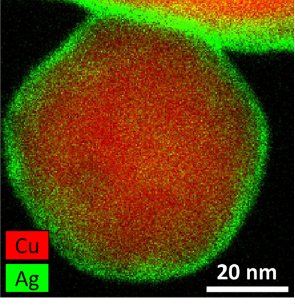
Furthermore, the development of copper-based ECA is underway to further reduce the use of silver. Core-shell copper-silver particles with high oxidation resistance have been tested as conductive fillers, demonstrating electrical resistivities comparable to those of commercial ECA.