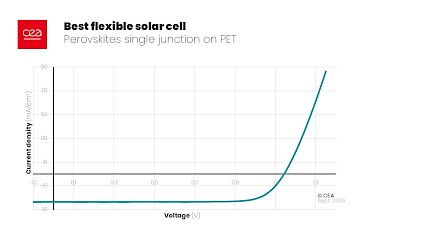
Researchers from the CEA at INES have achieved an efficiency of 21.2% for flexible perovskite solar cells on a PET substrate. This efficiency is close to the world record for flexible cells, even though it was achieved on devices with an active area nearly three times larger.

21.2% is our new record for flexible perovskite solar cells
Published on 09/28/2026
Perovskite-based solar cells are one of the most promising advances in the field of photovoltaic solar energy. Made from cost-effective and easily processed materials, they now achieve conversion efficiencies of up to 28% for rigid panels. Impressive.
The version adapted for flexible, lightweight substrates is also making progress and has achieved a world-record efficiency of 24.52% on a still very small active area of 0.092 cm². It is also attracting interest from the scientific community because it opens the door to new applications—such as smart textiles, space applications, or direct integration into buildings—while enabling large-scale industrial production.
But, as is often the case, it’s not that simple. Manufacturing these flexible devices requires lower temperatures during heating to avoid damaging the polymer. This thermal constraint can lead to minor defects in the structure of the cells and reduce their efficiency compared to rigid materials such as glass. To overcome this challenge, researchers are developing low-temperature manufacturing techniques, protective chemical treatments, and advanced printing methods to produce flexible solar panels that are durable, high-performing, and ready for the commercial market.
CEA researchers at INES have reached a major milestone in the development of these flexible perovskite-based solar cells.
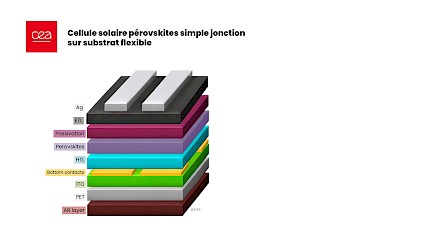
By incorporating an anti-reflective coating and redesigning the electrical connections, our teams have successfully reduced energy losses. With this innovation, our laboratories have set a new internal record by increasing the efficiency of these cells from 19.2% to 21.2%. This excellent result comes close to the current world record for flexible perovskite cells (24.52%), even though it was achieved on a surface area nearly three times larger (0.28 cm²). It demonstrates that it is possible to scale up these flexible cells while maintaining excellent efficiency.
The performance and reliability of these flexible solar cells can be improved in the future, particularly by optimizing all of their composing layers. Conductive materials will need to be tested and adapted to better extract current and enhance the panels’ resistance to environmental conditions.
At the same time, it will also be worthwhile to adapt the process to new flexible substrates that are more resistant to heat, mechanical deformation, and radiation, with an eye toward space applications, as suggested in the JUMP INTO SPACE project.
This work was conducted as part of the European JUMP INTO SPACE project, one of whose objectives is to develop a single-junction perovskite cell architecture on a flexible substrate.